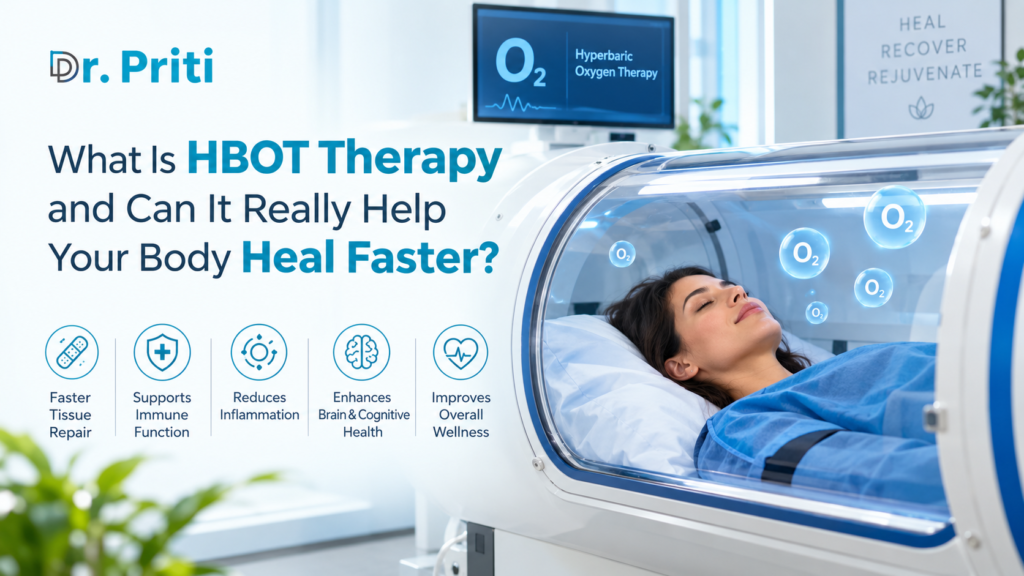
Have you ever wondered why some wounds, injuries, or recovery processes seem to take much longer than expected? Could giving the body more oxygen actually support the natural healing process? Best HBOT Therapy in gurugram is increasingly being explored by people interested in wound healing, recovery, rehabilitation, and advanced wellness care. But what exactly happens inside an HBOT chamber? Can it really help the body heal faster? And is it suitable for everyone?
These are important questions because Hyperbaric Oxygen Therapy is not simply “breathing more oxygen.”
HBOT is a medical therapy in which a person breathes high-concentration oxygen inside a chamber where atmospheric pressure is increased. Under these conditions, more oxygen can dissolve into the blood plasma and reach tissues where oxygen availability may be limited.
But does more oxygen automatically mean faster healing?
Not necessarily.
The benefits of HBOT depend on the person’s condition, the reason for treatment, the treatment protocol, and appropriate medical supervision.
What Exactly Is HBOT Therapy?
HBOT stands for Hyperbaric Oxygen Therapy.
During treatment, you breathe oxygen inside a specially designed pressurised chamber. Increasing the surrounding pressure allows oxygen to dissolve more readily into body fluids, potentially increasing oxygen delivery to certain tissues.
Why does that matter?
Because oxygen plays an important role in many normal healing processes. It contributes to cellular energy production, tissue repair, collagen formation, immune responses, and the development of new blood vessels.
This is why HBOT can be particularly relevant in selected medical situations where tissue oxygenation is compromised.
The FDA-recognised uses of hyperbaric oxygen include several specific conditions, such as certain difficult-to-heal wounds, carbon monoxide poisoning, decompression sickness, selected infections, radiation injuries, and compromised grafts or flaps.
So HBOT has legitimate medical applications—but it should not be presented as a universal treatment for every health problem.
How Could More Oxygen Support Healing?
Think about a wound that isn’t healing properly.
What does damaged tissue need to repair itself?
It needs adequate blood supply, oxygen, nutrients, immune activity, and time.
When circulation is poor, oxygen delivery can become limited. This can make tissue repair more difficult.
HBOT increases oxygen availability while the person is inside the pressurised chamber. This can create a temporary environment with higher tissue oxygenation, which may support processes involved in healing.
At Peak Wellness, the HBOT programme is designed around this principle. The clinic describes HBOT as supporting tissue oxygenation, wound healing, circulation, collagen production, and tissue repair.
But the important word is support.
HBOT does not magically repair damaged tissue overnight.
Healing remains a biological process involving many factors.
Could HBOT Help Difficult-to-Heal Wounds?
This is one of the areas where HBOT has a recognised clinical role.
Why do some wounds refuse to heal?
Diabetes, poor circulation, infection, tissue damage, and other medical conditions can interfere with normal wound repair.
Selected problem wounds may benefit from hyperbaric oxygen as part of a comprehensive treatment plan. FDA documentation lists enhancement of healing in selected problem wounds among recognised HBOT uses.
At Peak Wellness, diabetic wound healing is one of the areas included within its HBOT programme. The clinic emphasises that HBOT should be integrated with appropriate medical, nutritional, and functional care rather than used as a replacement for essential wound management.
That distinction is extremely important.
If you have a diabetic wound, for example, proper wound care, infection management, blood-sugar management, nutrition, and medical monitoring remain essential.
Can HBOT Support Recovery After Injury or Surgery?
Could oxygen also matter when your body is recovering from an injury?
Absolutely, oxygen is part of normal tissue repair.
After certain injuries or surgical procedures, the body enters a complex repair process involving inflammation, new tissue formation, collagen production, and blood-vessel development.
HBOT may be considered in selected circumstances to support healing, particularly where tissue oxygenation is a concern.
However, not every injury requires HBOT.
A minor sports injury and a difficult-to-heal surgical wound are completely different situations.
This is why medical assessment should come before deciding that HBOT is necessary.
What About Brain and Neurological Recovery?
This is another area that generates a lot of interest.
Could increasing oxygen availability help the brain?
The brain has a high demand for oxygen, so oxygen delivery is obviously important for normal neurological function. HBOT has been studied in various neurological and rehabilitation settings.
Peak Wellness lists neurological and cognitive concerns, stroke and neuro-rehabilitation, concussion recovery, migraines, and brain fog among areas it evaluates for HBOT.
However, this is an area where expectations need to remain realistic.
Not every neurological condition has strong evidence supporting HBOT, and HBOT should not be promoted as a guaranteed treatment for neurological disease.
The right question is:
“Is there good evidence for HBOT in my particular condition?”
That is a much better question than simply asking whether oxygen is good for the brain.
Can HBOT Help With Inflammation?
Could increasing oxygen availability influence inflammation?
HBOT may affect several biological processes involved in tissue repair and inflammatory responses. This is one reason researchers continue investigating its potential applications.
At Peak Wellness, HBOT is integrated into a broader functional-medicine approach that may include nutritional support, lifestyle strategies, and other therapies when clinically appropriate.
But again, HBOT shouldn’t be treated as a universal anti-inflammatory solution.
Chronic inflammation can have many possible causes, including metabolic problems, autoimmune conditions, lifestyle factors, infections, poor sleep, and other medical issues.
Understanding the underlying cause remains important.
What Happens During an HBOT Session?
Are you imagining something complicated when you hear “hyperbaric chamber”?
The actual experience can be fairly straightforward.
At Peak Wellness, the process begins with a medical assessment to determine whether HBOT is appropriate. The clinic uses a monoplace hyperbaric chamber, and typical sessions are described as lasting around 60–90 minutes, depending on the treatment plan.
During the session, you breathe oxygen while the chamber pressure is gradually adjusted.
You may notice pressure or fullness in your ears during changes in pressure—similar to the sensation experienced during an airplane flight.
Patients can generally relax during the session, and the treatment is monitored.
Is HBOT Safe?
This is perhaps the most important question.
HBOT is a medical therapy, so “non-invasive” does not mean “risk-free.”
Some people can experience ear or sinus discomfort from pressure changes. Oxygen exposure and chamber pressure also require appropriate protocols and medical oversight.
Certain health conditions may require special precautions or make HBOT unsuitable.
That’s why a proper assessment matters.
At Peak Wellness, the clinic states that every HBOT candidate undergoes a medical assessment before beginning treatment, and sessions are planned and monitored under physician supervision.
In other words:
Don’t choose an HBOT centre only because it has a chamber. Choose a setting where your medical suitability is taken seriously.
How Many HBOT Sessions Might You Need?
Is one session enough?
Usually, treatment planning depends heavily on the reason for therapy.
Someone seeking general wellness support may have a very different plan from someone undergoing treatment for a recognised medical indication.
Peak Wellness describes 10 sessions as a common starting point for some wellness and performance goals, while therapeutic conditions may require longer protocols. The clinic states that the final recommendation depends on the individual’s condition and assessment.
There is no universal number that guarantees results.
The appropriate course should be determined by the treating medical professional.
Why Choose Peak Wellness for HBOT?
If you’re researching Best HBOT Therapy in gurugram, shouldn’t the medical expertise behind the treatment matter just as much as the technology?
At Peak Wellness, HBOT is positioned as a physician-led therapy rather than simply a chamber-based wellness service.
The clinic states that HBOT sessions are personally planned and monitored by Dr. Priti Nanda Sibal, and that the centre uses an FDA-standard monoplace chamber from Oxycea Hyperbaric Chambers.
Peak Wellness also integrates HBOT into its functional-medicine approach, considering factors such as nutrition, lifestyle, metabolic health, and the individual’s broader health goals.
The clinic’s current profile describes Dr. Priti Nanda Sibal as a GMC Amritsar graduate and ABAARM-certified physician with more than 30 years of clinical experience.
What makes this approach different?
Medical assessment before treatment:
The goal is to determine whether HBOT is appropriate before starting sessions.
Physician-led protocols:
Treatment is planned according to the individual’s condition and goals.
Medical-grade equipment:
Peak Wellness uses a monoplace hyperbaric chamber and describes it as FDA-standard.
Functional-medicine integration:
HBOT can be considered alongside nutritional and lifestyle support when clinically appropriate.
Personalised treatment planning:
Rather than assuming everyone needs the same number of sessions, the treatment plan is based on individual circumstances.
Can HBOT Really Make Your Body Heal Faster?
The honest answer is:
It can support healing in selected medical situations, but it is not a guaranteed shortcut to recovery.
HBOT has recognised clinical uses, particularly in certain wounds and other specific conditions.
For other uses—especially general wellness, athletic recovery, anti-ageing, and some neurological applications—the evidence can be more variable.
That’s why responsible HBOT care should involve realistic expectations.
Your body still needs adequate nutrition, sleep, circulation, appropriate medical treatment, physical rehabilitation when required, and time to heal.
HBOT may be one component of that bigger picture.
Final Thoughts
So, what is HBOT therapy?
It is a medical treatment that combines high-concentration oxygen with increased atmospheric pressure to increase oxygen availability to the body’s tissues.
Could that help the body heal?
In selected circumstances, yes.
But the real value of HBOT depends on choosing the right patient, the right indication, the right protocol, and the right level of medical supervision.
If you’re considering HBOT, don’t begin with:
“How many sessions should I buy?”
Start with:
“Is HBOT appropriate for my condition, and what evidence supports using it?”
That conversation can help you make a safer and more informed decision.
FAQs
1. What does HBOT stand for?
HBOT means Hyperbaric Oxygen Therapy.
2. How long is an HBOT session?
Sessions at Peak Wellness are typically around 60–90 minutes.
3. Can HBOT help wounds heal?
It may support healing of selected difficult-to-heal wounds.
4. Is HBOT suitable for everyone?
No. Medical assessment is important before treatment.
5. How many HBOT sessions are needed?
The number depends on your condition, goals, and medical assessment.